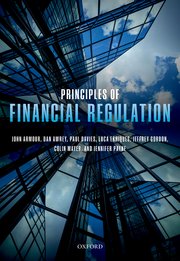
The Sustainable Finance Foundation is pleased to highlight Principles of Financial Regulation, authored by John Armour, Dan Awrey, Paul Davies, Luca Enriques, Jeffrey N. Gordon, Colin Mayer, and Jennifer Payne, and published by Oxford University Press. OUP presents the book as a major work that “reconceptualises the field of financial regulation” by examining financial regulation in a purposive and dynamic way, focusing on what the financial system does rather than on narrow institutional categories alone. The paperback edition was published in September 2016, and OUP lists the book under ISBN 9780198786481.
This is an especially important book because of both its subject matter and the stature of its authors. The author team brings together some of the most prominent scholars in law, finance, and regulation. John Armour is Professor of Law and Finance at Oxford and a Fellow of the British Academy. Dan Awrey is the Beth and Marc Goldberg Professor of Law at Cornell Law School, with research centred on banks, investment funds, derivatives, payment systems, and financial market infrastructure. Paul Davies is a Senior Research Fellow at Harris Manchester College, Oxford, and formerly Allen & Overy Professor of Corporate Law, as well as a Fellow of the British Academy. Luca Enriques is Professor of Business Law at Bocconi University and was Professor of Corporate Law at Oxford until early 2025. Jeffrey N. Gordon is the Richard Paul Richman Professor of Law at Columbia Law School and co-director of major centres on global markets and corporate ownership. Colin Mayer is Emeritus Professor of Management Studies at Oxford’s Saïd Business School. Jennifer Payne is now Warden of Merton College, Oxford, and previously served as Linklaters Professor of Corporate Finance Law.
The strength of the book lies in its breadth and conceptual ambition. Rather than treating financial regulation as a collection of separate sectoral rules for banking, securities, insurance, and markets, the book asks more fundamental questions about the purposes of regulation and the functions performed by financial systems. That makes it particularly valuable for readers engaged in financial research. For academic researchers, policymakers, regulators, and practitioners, the book offers a framework that is analytical rather than merely descriptive. It helps readers understand why regulation exists, how it should be assessed, and what kinds of trade-offs regulation inevitably involves. OUP’s own description emphasises that the volume reframes the field around the economic and social functions of finance, which is one reason why it has become such an influential reference point.
From the perspective of financial research more broadly, Principles of Financial Regulation is highly significant because it sits at the intersection of law, economics, public policy, and institutional design. Financial research today increasingly requires that scholars move beyond narrow doctrinal categories. Questions of systemic risk, market structure, consumer protection, financial stability, prudential supervision, conduct regulation, technological change, and international coordination all demand an interdisciplinary perspective. A book of this kind is therefore useful not only for students of financial law, but also for those working in banking, capital markets, financial economics, political economy, and global governance. The authors’ collective expertise reflects that interdisciplinarity: their profiles span corporate law, market regulation, financial institutions, infrastructure, governance, and law-and-finance scholarship.
The book is also highly relevant to sustainable finance, even though it is not framed as a sustainability text in the narrow sense. Sustainable finance depends not only on climate targets, ESG disclosures, green bonds, or taxonomy frameworks. It also depends on the stability, integrity, and design of the wider financial system. Questions such as how markets are supervised, how financial institutions are governed, how risks are identified and allocated, how consumer and investor interests are protected, and how regulation responds to innovation and systemic fragility are all central to the long-term credibility of sustainable finance. A sustainable financial system must be not only greener, but also more resilient, more transparent, and better governed. That is precisely why a foundational work on financial regulation remains deeply relevant to sustainable finance research. This is an inference from the book’s subject matter and the present structure of sustainable finance debates, rather than a claim that the book itself is marketed as a sustainability title.
This connection becomes even clearer when one considers the evolution of sustainable finance policy in recent years. Across major jurisdictions, sustainable finance is becoming more closely connected to prudential supervision, systemic risk, disclosure quality, market conduct, data governance, and financial infrastructure. Those themes are not external to financial regulation; they are part of its contemporary development. A serious researcher in sustainable finance therefore needs not only knowledge of climate policy and ESG frameworks, but also a deeper understanding of the principles that structure financial regulation as a whole. In that respect, Principles of Financial Regulation provides intellectual foundations that remain highly useful for sustainable finance scholarship and policy analysis. Again, this is best understood as a reasoned assessment of the book’s relevance rather than as a claim about the publisher’s marketing language.
Another reason the book deserves attention is the quality of the author team as a collective enterprise. Several of the authors are among the leading figures in the global law-and-finance field. John Armour’s work bridges company law, finance, and institutional design. Dan Awrey’s research covers financial institutions, derivatives, payment systems, and market infrastructure. Paul Davies has long been one of the most influential scholars in corporate and financial law in the UK. Luca Enriques is a major figure in corporate and securities law in Europe. Jeffrey Gordon brings deep expertise in corporate governance and the regulation of financial institutions from Columbia. Colin Mayer’s work on business purpose, governance, and financial systems adds a broader institutional perspective. Jennifer Payne has written extensively on company law, corporate finance law, financial regulation, and insolvency. That breadth gives the book a level of authority that few single-author works in the area could match.
For readers of the Sustainable Finance Foundation, the importance of the book lies in its ability to widen the frame. Sustainable finance is often discussed in terms of products and labels: green loans, ESG funds, transition bonds, sustainability-linked finance, or corporate disclosure regimes. Those are important manifestations of the field, but they do not exhaust it. Sustainable finance also depends on the deeper conditions of financial order: sound regulation, credible supervision, institutional trust, and a coherent understanding of what finance is meant to do in society. Principles of Financial Regulation is valuable precisely because it addresses those more foundational issues. It helps remind readers that finance is a system, regulation is purposive, and sustainability ultimately depends on the quality of both. This final point is a substantive evaluation drawn from the book’s theme and the broader field, rather than a direct publisher statement.
The book is available directly from Oxford University Press. It is also listed by major booksellers including Waterstones, Blackwell’s, Wildy, and Amazon UK. A digital version is also available via VitalSource. Availability and pricing may vary by retailer and region.

Leave a comment