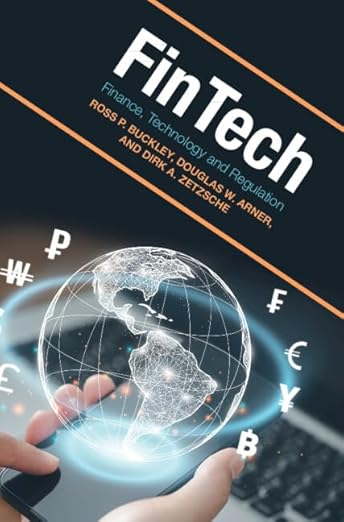
The Sustainable Finance Foundation is pleased to note the publication of FinTech: Finance, Technology and Regulation, a significant new work by Ross P. Buckley, Douglas W. Arner, and Dirk A. Zetzsche.
The book offers a wide-ranging examination of how finance, technology, and regulation interact in reshaping the contemporary financial system. Covering developments such as artificial intelligence, blockchain, digital payments, Big Data, cloud computing, cryptocurrencies, central bank digital currencies, and platform-based finance, it provides an important account of the legal and regulatory questions raised by financial innovation.
Although the volume is not exclusively focused on sustainable finance, it is highly relevant to the field. Sustainable finance is not only concerned with environmental objectives, ESG disclosures, or transition strategies. It also depends on the wider architecture of financial systems: the quality of regulation, the resilience of market infrastructure, the accessibility of financial services, and the ability of innovation to support transparency, accountability, and long-term capital allocation. In this respect, the study of FinTech has become increasingly important to understanding the future direction of sustainable finance.
This relevance is visible in several ways. First, digital finance is becoming part of the infrastructure of sustainable development. Financial technology can lower transaction costs, widen access to finance, improve efficiency, and support new channels of capital mobilisation. These dynamics are especially important in emerging and developing markets, where digital finance has already played a transformative role in payments, remittances, and financial inclusion.
Second, financial innovation creates regulatory challenges that sustainable finance cannot ignore. A financial system shaped by data concentration, cyber risk, platform dominance, opacity, and fragmented regulation may weaken the credibility of sustainability objectives if legal and supervisory frameworks fail to keep pace. Sustainable finance therefore requires not only ambition, but also robust governance and institutional design.
Third, the future of sustainable finance is likely to be digital as well as green. Whether in relation to tokenised assets, digital identity, programmable money, digital payment systems, ESG data infrastructures, or new forms of intermediation, finance is undergoing structural technological change. Understanding that transformation is increasingly necessary for regulators, scholars, and practitioners working on sustainable finance and financial policy more broadly.
The publication is also notable for the standing of its authors, all of whom are internationally recognised for their work in financial law, regulation, and innovation. Their combined expertise gives the book particular value for those seeking to understand not only the technologies themselves, but also the broader legal and regulatory frameworks that will shape their development.
From the perspective of the Sustainable Finance Foundation, this is a timely and important contribution. It serves as a reminder that the future of finance will be shaped not only by sustainability goals, but also by the technologies, institutions, and regulatory systems through which finance is organised and delivered. For readers interested in the relationship between innovation, regulation, and sustainable development, this is a valuable book that merits close attention.
The book is available from Cambridge University Press and Waterstones. Readers may also wish to check major online bookselling platforms such as Amazon, Wildy, Hive, Blackwell’s, and Cambridge Bookshop for current availability and regional pricing.

Leave a comment