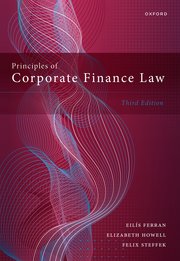
The Sustainable Finance Foundation is pleased to note the publication of Principles of Corporate Finance Law by Eilís Ferran, Elizabeth Howell, and Felix Steffek, published by Oxford University Press. The third edition was published in 2023 and is presented by OUP as a multidisciplinary work combining company law, capital markets law, and aspects of commercial and insolvency law in order to give readers a detailed understanding of the legal and regulatory framework for corporate finance. OUP lists the paperback edition under ISBN 9780198865353.
The authors are among the leading scholars in the field. Eilís Ferran is widely known for her work in company, securities, and financial regulation; Elizabeth Howell is a leading academic in corporate finance law; and Felix Steffek is well known for his scholarship in corporate law, finance, and related areas of commercial law. Their collaboration gives the volume both doctrinal depth and strong policy relevance. The book’s interdisciplinary design is one of its principal strengths, because corporate finance law cannot be understood purely through company law doctrine alone; it sits at the intersection of capital markets, creditor protection, insolvency, disclosure, governance, and financial intermediation.
Although the book is not written specifically as a sustainable finance text, it is highly relevant to the sustainable finance agenda. Sustainable finance ultimately depends on the legal frameworks through which firms raise capital, allocate risk, structure investor and creditor rights, and navigate the tension between short-term market pressures and long-term financing needs. Questions of equity and debt finance, capital structure, disclosure, governance, and creditor protection are not peripheral to sustainable finance. They are among the legal foundations on which sustainable investment, transition finance, and long-term productive finance must rest. OUP’s own description emphasises that the book gives readers a detailed understanding of the legal and regulatory framework for corporate finance by combining multiple branches of law rather than treating corporate finance as a narrow technical subject.
This is especially important in the present policy environment. Across major jurisdictions, sustainable finance increasingly depends on mobilising capital for transition, resilience, infrastructure, and long-term business transformation. Yet these goals cannot be achieved merely through ESG language, climate targets, or disclosure frameworks. They also require robust legal structures governing how capital is raised, how investors are protected, how creditors are treated, and how risk is distributed inside the firm. A book such as Principles of Corporate Finance Law is therefore valuable not only for corporate lawyers and academics, but also for anyone interested in the institutional conditions under which sustainable finance can function credibly and at scale.
From the perspective of the Sustainable Finance Foundation, the book is particularly useful because it reminds readers that sustainable finance is not only about green labels or regulatory innovation at the margins. It also depends on the deeper architecture of finance law. The financing of decarbonisation, adaptation, sustainable infrastructure, and long-term enterprise development all presuppose legal systems capable of structuring capital formation in a stable, credible, and efficient manner. In that sense, a major work on corporate finance law speaks directly to the broader sustainable finance debate, even where sustainability is not its primary express focus. That wider relevance is one reason why this volume deserves attention from scholars, practitioners, policymakers, and advanced students working across corporate law, financial regulation, and sustainable finance.
The book is available directly from Oxford University Press, and it is also listed by major booksellers including Amazon UK, Blackwell’s, and Wildy. Digital versions are also available through platforms such as VitalSource. Availability and pricing may vary by retailer and region.

Leave a comment