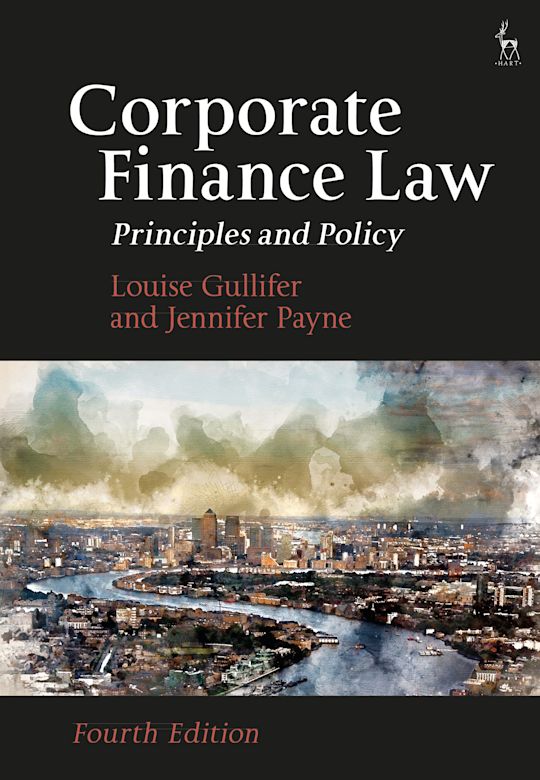
The Sustainable Finance Foundation is pleased to note the publication of the 4th edition of Corporate Finance Law: Principles and Policy by Louise Gullifer and Jennifer Payne, published by Hart Publishing, an imprint of Bloomsbury Publishing. Bloomsbury describes the book as an acclaimed and fully updated treatment of key theoretical and policy issues in corporate finance law, with one of its distinctive features being its equal attention to both the equity and debt sides of corporate finance. The new edition was published on 4 September 2025 and is available in paperback, hardback, and ebook formats.
The authors are among the leading scholars in the field. Louise Gullifer is Rouse Ball Professor of English Law at the University of Cambridge, while Jennifer Payne is Warden of Merton College, Oxford, and previously served as Linklaters Professor of Corporate Finance Law at the University of Oxford. Their combined expertise gives the book particular authority for academic, professional, and policy audiences interested in the legal structures of finance and markets.
Although Corporate Finance Law: Principles and Policy is not a book written specifically on sustainable finance, it is highly relevant to the field. Sustainable finance ultimately depends on the legal and institutional architecture through which firms raise capital, allocate financial risk, protect creditors and investors, and structure long-term relationships between companies and providers of finance. Questions of corporate funding, disclosure, governance, debt, equity, and capital allocation are not secondary to sustainable finance. They are among its core legal foundations. A serious understanding of how sustainable investment, transition finance, and long-term productive finance can operate in practice therefore requires close attention to corporate finance law.
This relevance is especially visible in the current policy environment. Across major jurisdictions, sustainable finance is increasingly tied to long-term investment in energy transition, climate adaptation, resilient infrastructure, and wider forms of productive capital formation. Yet these ambitions can only be realised through legal systems that make capital-raising possible, allocate risk in a coherent way, and provide confidence to market participants. Bloomsbury’s description of the book emphasises precisely this wider significance: it examines the debt- and equity-raising choices of companies of all sizes, from SMEs to the largest publicly traded enterprises, and analyses the mechanisms through which those providing capital are protected. Each chapter, Bloomsbury notes, analyses the present law critically to show the difficulties, risks, and tensions in this area and the attempts made by legislators, courts, and market actors to address them.
From the perspective of the Sustainable Finance Foundation, this makes the book more than a specialist corporate law textbook. It is also a contribution to understanding the wider legal preconditions of sustainable markets. Sustainable finance is often discussed through the language of ESG, climate disclosure, taxonomies, or green bonds. Those subjects remain important, but they do not displace the deeper legal architecture of capital formation. Corporate finance law determines how firms obtain funding, how the interests of shareholders and creditors are balanced, how law responds to financial distress and risk, and how confidence in financial markets is maintained. These questions are central to the financing of sustainable development and transition.
The breadth of the book is another reason it deserves attention. Bloomsbury presents the 4th edition as fully updated to reflect developments in law and markets, and the size of the new edition—944 pages—suggests the scale and seriousness of its treatment. For scholars, practitioners, regulators, and advanced students, the volume offers not only doctrinal coverage but also sustained engagement with theoretical and policy issues. That combination is particularly valuable in a period when debates over finance increasingly require both technical legal understanding and broader policy judgment.
The book is available directly from the publisher at Bloomsbury / Hart Publishing. It is also listed by major booksellers including Waterstones and Amazon UK. Readers may also wish to check specialist and academic booksellers such as Wildy, as availability and pricing may vary by retailer and over time.
For readers interested in the legal foundations of finance, the structure of capital-raising, and the wider institutional conditions under which sustainable finance must operate, Corporate Finance Law: Principles and Policy is a major publication that merits close attention. Its value lies not only in explaining the rules of corporate finance law, but also in illuminating the tensions, trade-offs, and policy choices that shape modern financial systems. In that respect, it is highly relevant to the broader agenda of sustainable finance and long-term market development.

Leave a comment